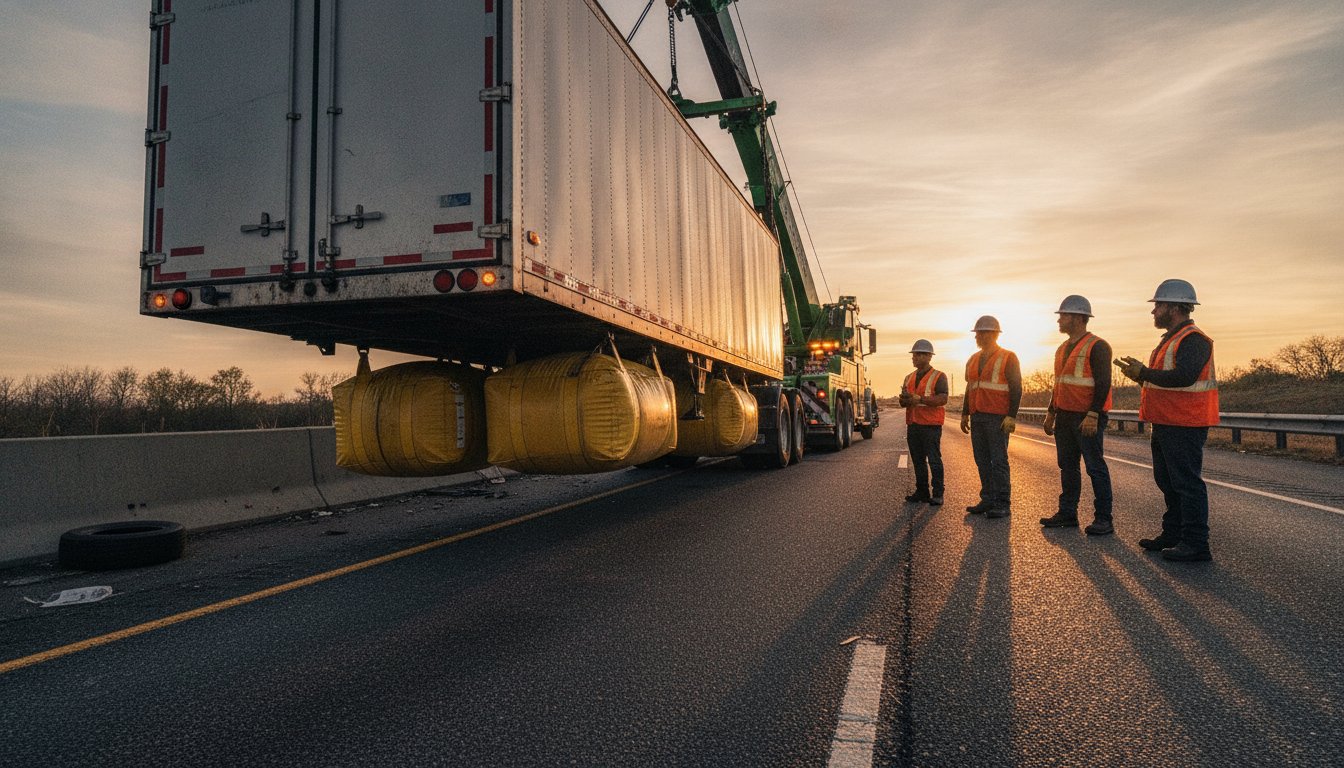
In a high-stakes rollover, the traditional hook and pull method often causes more structural damage to the trailer and cargo than the initial accident itself. When your rig is down, the pressure to clear the lane is immense, but rushing with heavy chains can lead to a total loss of both the equipment and the precious freight inside. You’ve worked hard to maintain your fleet, and we understand that a single recovery shouldn’t result in a crushed trailer frame or a scattered load.
This is where specialized airbag recovery for semi trucks serves as a critical, damage-free alternative. Instead of relying on brute force, this method uses low-pressure lifting cushions to gently right the vehicle while distributing weight evenly across the surface. It is the surgical choice for professional operators who need to protect their bottom line. In this guide, you’ll discover how these specialized tools salvage the maximum amount of cargo and protect your rig during complex heavy-duty accidents. We will walk through the mechanics of the lifting process, the specific benefits for sensitive loads, and how our team in Dayton, TX, uses this technology to clear accident scenes safely and efficiently.
Key Takeaways
- Learn why specialized inflatable cushions are the safest method to upright an overturned rig without causing secondary structural damage.
- Understand the science of weight distribution and how low-pressure bags prevent the “can opener” effect often caused by traditional chains.
- Discover how specialized airbag recovery for semi trucks offers a higher return on investment by salvaging cargo that traditional winching might destroy.
- Follow the professional step-by-step recovery sequence, from identifying trailer hard points to stabilizing the scene for a controlled lift.
- See why a local team based in Dayton, TX, provides the rapid response needed to clear major highway blockages and minimize liability.
What is Airbag Recovery for Semi Trucks?
Airbag recovery for semi trucks is a specialized technique that uses high-capacity inflatable cushions to upright overturned trailers and tractors. Unlike the safety airbags found inside your cab, which deploy in milliseconds to protect the driver, recovery airbags are industrial tools inflated slowly with a pneumatic controller. They are the preferred choice for incidents where preserving the structural integrity of the trailer is just as important as clearing the road. This method is often called the gold standard for salvage because it eliminates the concentrated stress points created by traditional steel cables.
We typically deploy these cushions in complex scenarios. If a trailer is resting on its side or roof, or if a rig is jackknifed in a way that prevents a standard tow, airbags provide the necessary lift. They are especially useful for soft-ground recoveries where a heavy wrecker might lose its footing. By placing these bags strategically, we can lift a fully loaded trailer without the risk of the frame buckling or the side walls tearing open. It’s a methodical process that prioritizes stability over brute force.
The History of Pneumatic Lifting in Heavy Recovery
The technology behind these cushions didn’t start on the highway. It actually evolved from aerospace and maritime salvage operations. Engineers needed a way to lift heavy, fragile structures without causing surface damage. This tech eventually transitioned into the heavy-duty towing industry as operators looked for ways to handle increasingly complex commercial accidents. To understand the physics involved, you can look at How Recovery Airbags Work through the lens of pneumatic pressure and surface area. In the towing industry, recovery airbags are defined as pneumatic tools for damage-free lifting that replace rigid jacks with flexible, high-capacity support.
When to Call for an Airbag Recovery Team
Deciding between traditional winching and airbag recovery depends on several factors. Knowing when to request airbag recovery for semi trucks can be the difference between a minor repair and a totaled trailer. Our team assesses the situation based on the following criteria:
- Trailer Orientation: If the trailer is on its roof or at a steep side angle, airbags provide a controlled descent that winches cannot match.
- Cargo Value: When the contents are high-value, fragile, or liquid, the concentration of force from chains can lead to a total loss of the load.
- Environmental Stability: On soft shoulders or mud, airbags distribute the weight over a wide area, preventing the vehicle from sinking further during the lift.
Choosing the right method early in the process saves time and prevents unnecessary liability. When you’re facing a major highway blockage, the priority is a quick, safe clearance that respects the value of your equipment. We understand the stress of these moments and focus on providing a calm, competent response to get your fleet back on track. To see how these professional standards are maintained by industry experts in other regions, you can learn more about Done Wright Towing & Transport.
The Mechanics: How Heavy-Duty Recovery Airbags Work
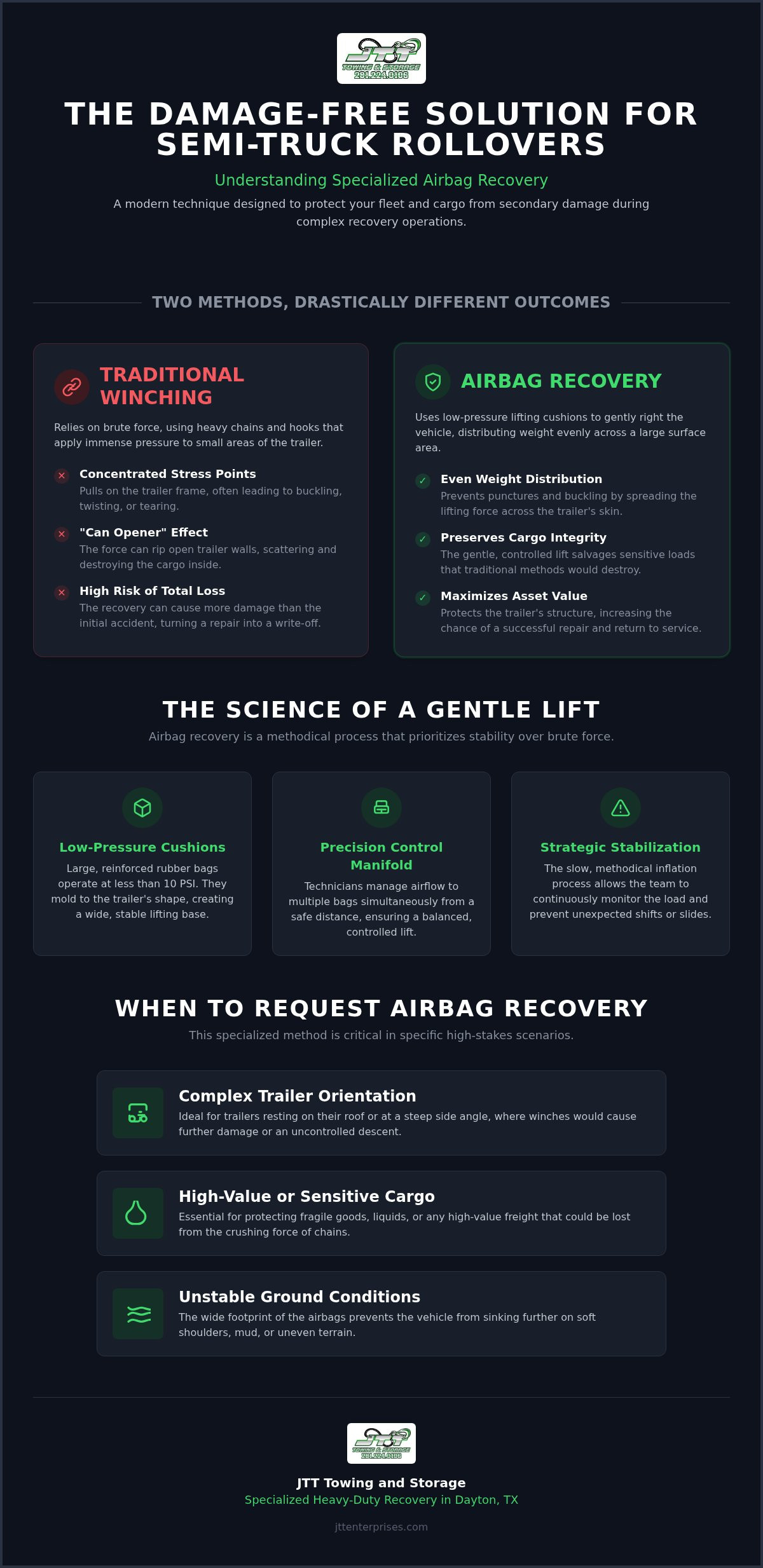
Airbag recovery for semi trucks works by applying the fundamental physics of surface area to heavy-duty lifting. When a trailer is on its side, the skin is incredibly vulnerable to punctures. Traditional recovery methods concentrate thousands of pounds of force into a single point, like a chain or a hook. In contrast, an air bag spreads that weight across several square feet. This distribution reduces the pressure on the trailer’s aluminum skin, preventing it from tearing or buckling under its own weight. It’s a calculated approach that treats your equipment with the respect it deserves.
The heart of the recovery system is the control manifold. This device allows our technicians to manage multiple bags simultaneously from a safe distance. By adjusting the airflow to each cushion, we maintain a balanced center of gravity throughout the lift. This precision is vital for preventing the truck from sliding or shifting unexpectedly. Because we operate in the intense Texas sun, we use bags made from multi-layered, reinforced rubber. These materials resist the softening effects of high heat and the sharp edges of highway debris often found at accident scenes.
Low-Pressure Air Bags: The Gentle Giants
Low-pressure bags are the primary tools for uprighting large trailers. They typically operate at less than 10 PSI. Because they’re flexible, they mold to the trailer’s shape, effectively wrapping around the corner of the box. This provides a massive amount of lift with very little internal pressure. The inflation process is slow and methodical, which gives our team time to monitor the load’s stability. For a detailed look at safety protocols, you can review the Step-by-Step Airbag Recovery Process used in military vehicle salvage to understand the risks involved in heavy lifting.
High-Pressure Bags: For Focused Power
High-pressure bags are smaller and more rigid. We use them for the initial gap when a truck is pinned close to the ground or to lift heavy chassis components like the engine block or axles. While they offer immense lifting capacity, they don’t provide much height. To gain more vertical reach, we sometimes stack these bags. However, stacking requires strict adherence to safety rules to prevent a kick out. Using high-pressure bags is a key part of airbag recovery for semi trucks when clearance is tight. If you’re unsure which method your specific situation requires, our team can provide an on-site assessment to determine the safest path forward.
Airbags vs. Traditional Winching: Protecting Your Cargo
Traditional winching relies on steel cables and high-tension pulls. While effective for simple wrecks, it often creates a “can opener” effect on trailers. When a hook is attached to a thin aluminum rail, the force can rip through the metal like paper. Airbag recovery for semi trucks avoids this risk by using pneumatic pressure to lift the entire side of the trailer at once. This method is often the deciding factor in whether a load is delivered or dumped. It replaces the violent tug of a winch with a steady, upward force that respects the trailer’s design limits.
Safety for on-scene responders is another major advantage. High-tension cables can snap, creating a lethal hazard for everyone nearby. Airbags operate under controlled pressure, significantly reducing the tension required from wreckers. You can read more about the technical differences in Airbags vs. Traditional Winching to see why emergency crews prioritize these tools for heavy lifts. Often, a single technician using a manifold can right a truck faster than three wreckers working in tandem. This efficiency clears the highway sooner and reduces your liability for traffic blockages.
Cargo Salvage: The Financial Difference
The financial impact of successful cargo salvage is hard to overstate. If you’re hauling 40,000 lbs of electronics or refrigerated food, a single pallet spill can trigger a massive insurance claim. Airbags keep the load level during the uprighting process. This prevents the shifting that leads to crushed boxes or broken seals. By salvaging the load, fleet owners protect their insurance premiums and maintain their reputation with shippers. We’ve seen scenarios where a full load was righted without a single pallet tipping, turning a potential total loss into a standard delivery.
Preventing Secondary Damage to the Rig
Beyond the cargo, we focus on the rig’s long-term health. Traditional pulls can twist a trailer frame or damage the refrigeration unit (reefer) if the angle isn’t perfect. We use airbag recovery for semi trucks to preserve the trailer’s structural integrity. At JTT Towing, our goal is to keep your equipment roadworthy. By avoiding the torque of a heavy winch pull, we minimize the downtime your fleet faces after an accident. This careful approach is why Liberty County operators trust us as a reliable partner during highway emergencies. We don’t just clear the scene; we protect your investment.
Once the rig is back on its wheels, the next priority is often restoring the bodywork and paint to professional standards; for high-quality collision services, check out NW Houston Auto Repair and Collision.
The Step-by-Step Airbag Recovery Process
Airbag recovery for semi trucks is a highly technical, multi-phase operation. It requires a calm head and a steady hand to manage the immense weight of a commercial rig. Before a single bag is inflated, we perform a comprehensive scene assessment. We identify the trailer’s structural hard points, such as the frame rails or the kingpin area. This ensures we aren’t lifting against a weak spot that could buckle under pressure. Stability is our first priority. We use chocks and stabilizing jacks to make sure the rig doesn’t slide as the angle of the trailer changes during the uprighting process.
The entire operation is a dance of physics and patience. By using a pneumatic control manifold, our technicians can adjust the airflow to different sections of the truck independently. This level of control is what makes the process so effective for delicate loads. We don’t just push the truck up; we guide it back to its wheels while constantly monitoring the center of gravity to prevent a secondary rollover in the opposite direction. Fleet managers who want to understand the full scope of what this entails can learn more about professional overturned semi recovery services and how expert intervention protects both equipment and cargo after a rollover.
Phase 1: Stabilization and Prep
We start by clearing the area of sharp debris and jagged metal. Even though our bags are made of reinforced, multi-layered rubber, a sharp piece of highway debris can compromise the equipment. If the cargo has shifted significantly, we attempt to secure it internally before the lift begins. This step is vital for keeping the load balanced. We then establish a strict safety perimeter. No one enters the lift zone once inflation starts. This disciplined approach is why we’ve been a trusted partner in Liberty County for over a decade. We take the time to do it right because rushing leads to mistakes.
Phase 2: Controlled Inflation and Righting
The lift begins with starter bags. These smaller, high-pressure cushions create the initial gap needed for the larger, low-pressure cushions. As we pump air through the manifold, we monitor the trailer’s lean. We’re looking for the exact moment the weight shifts back toward the wheels. At this tipping point, the catch cable becomes the most important tool. A rotator or heavy wrecker holds the tension, allowing the truck to settle gently onto its tires. This prevents the rig from slamming into the pavement, which would destroy the suspension or blow out the tires. If you are facing a rollover on Highway 90 or I-10, you can request our professional recovery team to manage the scene with precision.
Specialized Airbag Recovery in Dayton, TX
JTT Towing and Storage operates as a dependable anchor for the commercial trucking industry in Southeast Texas. We recognize that an accident on a major artery like Highway 90 or I-10 doesn’t just stop one truck; it ripples through the entire regional supply chain. Our approach is centered on being a reliable guardian for our neighbors. We treat every rig with the same level of care we would give our own equipment. This personal accountability, combined with our specialized pneumatic lifting cushions, allows us to manage complex recoveries that other providers might shy away from.
Our on-site equipment includes high-capacity systems designed to handle the heaviest loads permitted on Texas roads. Airbag recovery for semi trucks requires more than just the right tools; it demands operators who understand the specific stresses placed on a vehicle during a rollover. We maintain a state of constant readiness to ensure that when an emergency happens, we can respond with the calm competence necessary to stabilize the scene and protect your assets. Our goal is always to clear the blockage quickly while ensuring the safety of all responders and the integrity of your freight.
Serving Dayton, Cleveland, and Liberty County
The geography of Liberty County presents unique challenges, from the dense pine woods to the unpredictable clay-heavy soil. Recovering a loaded trailer from a soft Texas shoulder requires a deep understanding of local ground conditions. We’ve spent over a decade perfecting our off-road recovery techniques to ensure that we don’t cause further damage while extracting a vehicle. Our long-standing partnerships with local law enforcement agencies allow us to coordinate scene clearing quickly. This reduces the time your driver is stranded and minimizes your liability for highway blockages. Learn more about our Heavy-Duty Towing in Dayton to see how our local expertise makes a difference in critical situations.
Why Experience Matters in Airbag Recovery
Safe pneumatic lifting is not a skill learned overnight. It involves rigorous training in pressure management, weight distribution, and rigging safety. At JTT Towing, our operators bring years of hands-on experience to every call. As a family-owned business with more than 10 years of service, we prioritize integrity and professional standards over quick fixes. We know that the reputation of your fleet is on the line during a recovery. Our commitment to excellence ensures that we salvage the maximum amount of cargo while keeping your equipment roadworthy. When the stakes are high and the pressure is on, you need a partner who understands the technical nuances of airbag recovery for semi trucks. Contact JTT for 24/7 emergency assistance and experience the peace of mind that comes with professional, local care.
Protect Your Investment with Professional Recovery
Selecting the right recovery method is the most important decision you’ll make following a rollover. Traditional winching often causes secondary damage that can total a trailer, but choosing airbag recovery for semi trucks ensures your equipment and cargo remain protected. By distributing weight across a broad surface area, this specialized technique eliminates the risk of structural punctures and frame twisting. It’s a surgical approach that prioritizes your bottom line and gets your drivers back on the road faster.
At JTT Towing and Storage, we’ve spent more than 10 years serving Dayton, Liberty, and the surrounding communities as a family-owned operation. We maintain specialized heavy-duty recovery equipment on-site to handle even the most complex highway incidents. Our team acts as a reliable guardian for your fleet, providing the calm competence you need during high-stakes emergencies. Don’t leave your cargo’s safety to chance when specialized help is just a phone call away.
Get 24/7 Airbag Recovery Support from JTT Towing and Storage
We are ready to stand by you and your drivers whenever you need us.
Frequently Asked Questions
Is airbag recovery more expensive than using a standard tow truck?
Airbag recovery involves specialized equipment and labor, which often carries a higher initial service fee than basic winching. However, the long-term cost is usually lower because it prevents trailer damage and cargo loss. Fleet owners often find that saving a high-value load justifies the specialized service. It’s an investment in asset protection rather than just a simple tow. Choosing this method helps you avoid the massive expense of a totaled trailer.
Can airbags lift a fully loaded 80,000lb semi truck?
Yes, professional systems are designed for this exact purpose. By using multiple high-capacity cushions in a coordinated lift, we can upright a fully loaded rig. The science of surface area allows the weight to be distributed so the trailer skin isn’t crushed. Technicians use a manifold to balance the air pressure across several bags. This ensures the 80,000lb load rises evenly and safely without compromising the structural integrity of the frame.
What happens if a recovery airbag punctures during the lift?
Modern recovery bags are constructed from multi-layered, reinforced neoprene or Kevlar to resist punctures. If a leak occurs, it’s typically a slow hiss rather than a sudden burst. Because we use multiple bags and stabilizing jacks, the load doesn’t just drop. We also clear the area of sharp debris before placement. This redundant safety approach ensures the rig remains stable even if a single cushion is compromised during the heavy lifting process.
How long does a typical airbag recovery take on the highway?
The duration depends on the complexity of the scene, but the actual lift often takes less than an hour once the bags are positioned. Setup and stabilization are the most time-consuming phases. In many cases, airbag recovery for semi trucks is faster than traditional winching because it requires fewer repositioning maneuvers. Clearing a major highway blockage quickly is a priority for our team. We focus on getting the road open and your driver safe.
Do insurance companies prefer airbag recovery over winching?
Many insurance adjusters prefer this method because it significantly reduces the likelihood of secondary damage claims. When cargo is salvaged and the trailer frame remains straight, the total claim payout is much lower. Using a damage-free method demonstrates a commitment to loss mitigation. Fleet managers should check their specific policies, but professional recovery is widely recognized as the industry best practice. It’s a proactive way to keep your insurance premiums from skyrocketing after an accident.
Will airbag recovery work if my truck is stuck in deep Texas mud?
Airbags are actually superior in soft soil or mud conditions. Unlike heavy wreckers that need solid ground for their outriggers, air cushions provide their own stable base by distributing weight over a wide area. This prevents the trailer from sinking further while it’s being uprighted. It’s a common solution for off-road recovery in Liberty County, where the ground can be unforgiving after heavy rains. We have the experience to manage these difficult Texas terrain challenges.
What kind of cargo is best suited for airbag recovery?
This method is ideal for fragile, high-value, or liquid loads. Refrigerated freight, medical supplies, and hazardous materials benefit most from the gentle, even lift. Because the trailer doesn’t experience the violent torque of a winch pull, the cargo stays on its pallets. If you’re hauling anything where a “can opener” effect on the trailer would result in a total loss, airbags are the necessary choice. It’s the best way to protect your freight.
Does JTT Towing offer airbag recovery near Cleveland, TX?
Yes, we provide 24/7 overturned semi recovery services throughout Cleveland, Dayton, and the surrounding Liberty County area. Our strategic location allows for a rapid response to incidents on Highway 59 and other local routes. We bring all the necessary specialized equipment directly to your scene. Our team understands the local logistics and works closely with law enforcement to clear your rig safely. We’re your trusted partner for heavy-duty emergencies in the region.