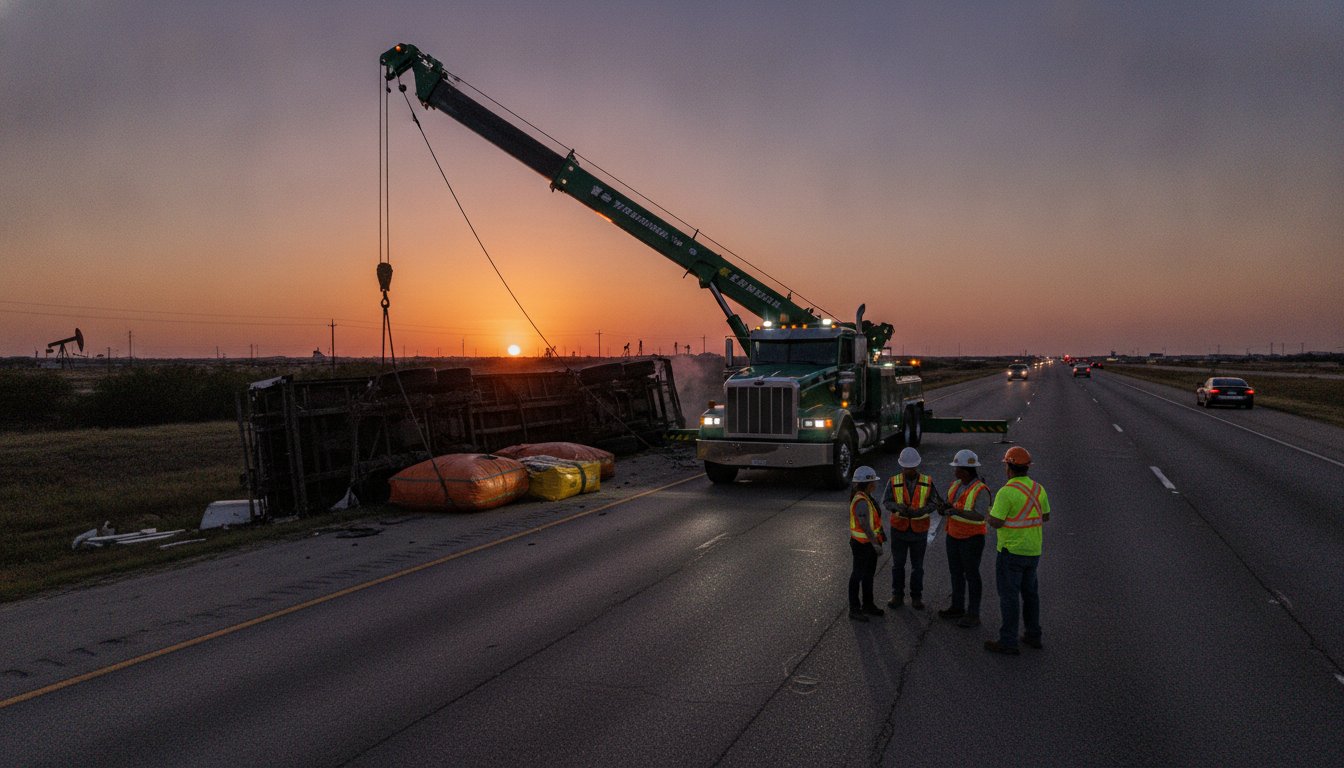
Imagine a fully loaded trailer resting on its side on a Dayton highway while the clock ticks on a critical delivery deadline. It’s a high-stakes moment where one wrong move by an operator can turn a recoverable accident into a total loss of both equipment and cargo. Most fleet managers and owner-operators understand that the initial crash is often just the beginning of the financial nightmare. The real damage frequently happens during the uprighting process when inexperienced teams use brute force instead of precision. This is why professional overturned semi recovery services are essential for protecting your bottom line.
Successful recovery is a surgical operation, not just a heavy lift. It requires balancing force and finesse to preserve your equipment. In this guide, you’ll discover the specialized technical process of heavy-duty recovery and learn how expert intervention saves your truck, trailer, and cargo after a rollover. We will explore the specific equipment used in these operations, such as high-capacity airbags, and explain how a methodical approach prevents secondary frame damage and avoids expensive environmental fines. By understanding the recovery process, you can ensure your fleet is back on the road with minimal disruption.
Key Takeaways
- Learn how recovery teams manage the complex physics of a rollover to prevent structural trailer damage during the uprighting process.
- Discover how specialized overturned semi recovery services utilize high-capacity airbags and rotators to upright casualties without destroying fragile cargo.
- Understand the critical steps of site assessment and stabilization that prevent further shifting or secondary damage to your equipment.
- Identify the logistical differences between load shift corrections and full cargo transfers to better protect your assets and minimize downtime.
- Gain insights into why local knowledge of Dayton terrain and strategic positioning on major highways is vital for a fast and effective response.
The Complexity of Overturned Semi Recovery Services
An overturned semi trailer is a complex puzzle of physics. When a rig rolls over, the center of gravity shifts drastically, placing immense stress on components never designed to bear weight from that angle. A standard trailer is engineered for vertical support through its axles and the fifth wheel. Once it’s on its side, the weight of the cargo pushes against the thin side walls and the longitudinal frame rails in ways that can cause immediate structural failure. Professional overturned semi recovery services must account for these forces before any lifting begins.
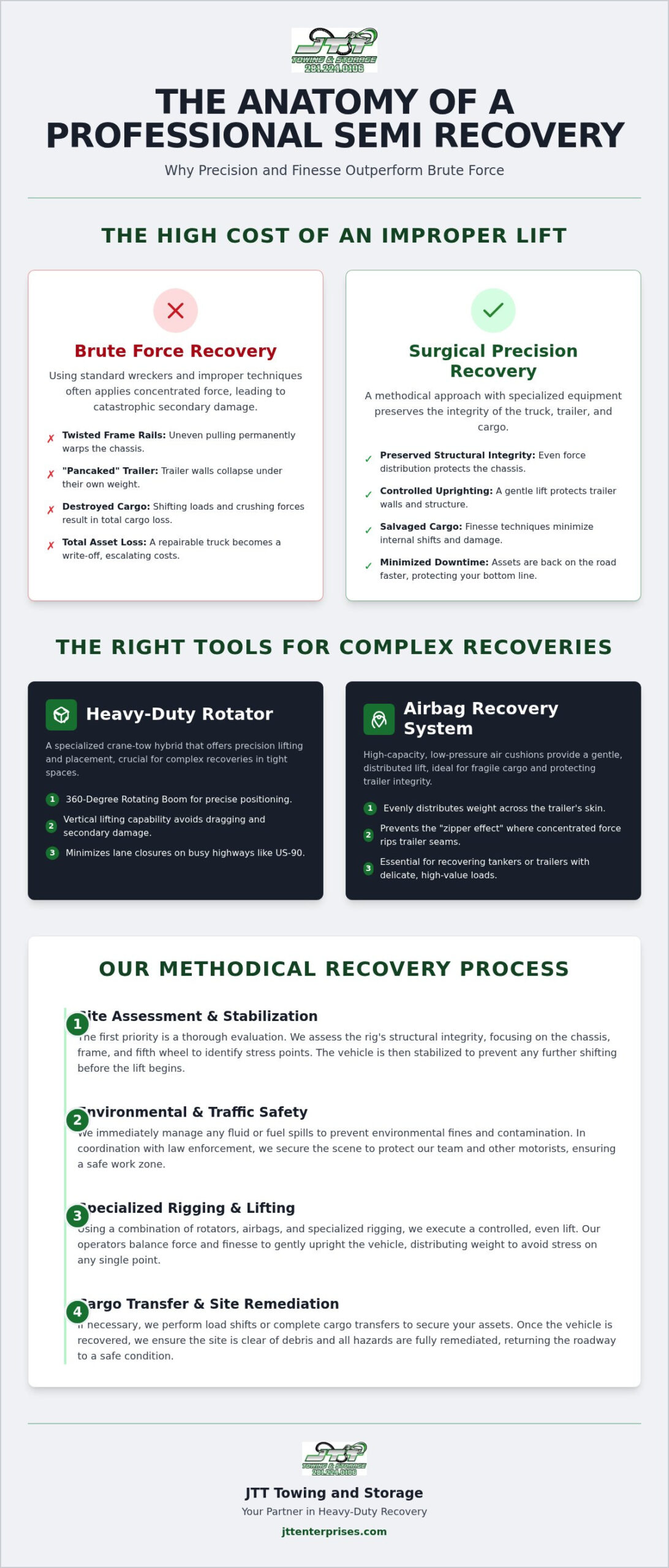
Standard towing equipment often fails in these high-capacity scenarios because it lacks the necessary reach and rotational control. While a traditional wrecker can pull a vehicle out of a ditch, it cannot easily manage the delicate roll required to upright a semi without causing the trailer to pancake. This is where specialized vehicle recovery methods become essential. Operators must use multiple points of attachment to ensure the weight is distributed evenly, preventing the frame from snapping under its own mass.
Assessing the Structural Integrity of the Rig
Before the first cable is tightened, a recovery supervisor must evaluate the chassis and the fifth wheel connection. These areas are prone to extreme stress during a rollover. If the kingpin is bent or the locking jaws are compromised, the tractor and trailer could separate mid-lift. Identifying potential frame twisting is also a priority. If an operator applies force to only one end of a loaded trailer, the resulting torque can permanently warp the frame rails, turning a repairable asset into a total loss. Professional recovery focuses on secondary damage prevention by stabilizing these stress points first.
Environmental and Traffic Safety Management
Heavy-duty accident scenes are inherently hazardous. A ruptured saddle tank can leak hundreds of gallons of diesel onto the roadway, leading to severe environmental fines and long-term soil contamination. Our team prioritizes managing fuel and fluid spills immediately to maintain compliance with environmental standards. Safety also extends to the surrounding area. We coordinate closely with Dayton law enforcement to manage traffic flow on busy routes like US-90. Securing the scene with proper lighting and barriers protects other motorists and allows our recovery teams to work without the threat of secondary collisions. This methodical approach ensures that overturned semi recovery services protect more than just the truck; they protect the community and the environment.
Specialized Equipment: Rotators and Airbags in Action
Modern overturned semi recovery services have evolved far beyond the simple “hook and pull” methods of the past. While traditional winching relies on brute force, it often applies concentrated pressure that can buckle a trailer’s frame or crush its side walls. Today, the focus is on finesse recovery, which uses advanced technology to upright a rig while protecting the owner’s investment. This approach is especially critical when dealing with the high-value cargo typical of Dayton’s logistics corridors. By using specialized rigging, operators can avoid the crushing forces that often occur when cables are wrapped directly around a trailer skin.
The Role of the Heavy-Duty Rotator
A heavy-duty rotator is a specialized crane-tow hybrid used for heavy lifting. Unlike a standard integrated wrecker, a rotator features a boom that can rotate a full 360 degrees. This allows the operator to position the recovery vehicle in a single lane, which is vital for minimizing highway closures on busy routes like US-90 or SH-146. By lifting the casualty vertically and rotating it into position, the team avoids the dragging motion that often causes secondary damage to the truck’s undercarriage or the road surface itself. This precision is essential in restricted spaces where there’s no room to maneuver a traditional tow truck.
Airbag Recovery: The Gentle Lift
When a trailer is loaded with fragile goods, air cushions provide a level of protection that cables simply cannot match. This process involves sliding uninflated, heavy-duty bags beneath the trailer and filling them with low-pressure air. The science behind this is simple: by increasing the surface area of the lift, the force is distributed evenly across the trailer’s skin. Professional overturned semi recovery services prioritize these cushions to prevent the “zipper effect,” a common disaster where the weight of a shifting load causes the trailer roof to tear open during a cable lift.
Air cushions are the preferred choice for several high-stakes scenarios:
- Refrigerated trailers with sensitive insulation panels.
- Fragile cargo like glass, bottled liquids, or unboxed electronics.
- Top-heavy loads that are prone to sudden shifting.
Using these tools requires a can-do attitude and deep technical knowledge. If your fleet encounters a rollover, relying on a partner with specialized airbag recovery equipment can be the difference between a successful delivery and a total insurance loss. Modern rigging techniques, combined with these specialized tools, ensure that the recovery process is as safe and efficient as possible.
The JTT Recovery Process: A Step-by-Step Breakdown
Every successful recovery starts with a cold, hard look at the scene. Our recovery supervisor begins with a comprehensive site assessment to identify immediate hazards. This includes checking for fuel leaks, downed power lines, and ground stability. It’s a methodical start that ensures the safety of everyone on site. Professional overturned semi recovery services aren’t just about moving a truck; they’re about managing a high-stakes environment with precision and care. We treat every incident as a unique technical challenge that requires a tailored plan of action.
Phase 1: Stabilization and Rigging
Stabilization is the next critical step. We don’t just start pulling. We secure the trailer to the tractor to prevent any separation during the lift. This is vital because the fifth wheel can become a pivot point for disaster if not properly managed. We use heavy-duty winch lines to anchor the vehicle, especially if it’s resting on a slope or a soft shoulder. This prevents the rig from sliding further into a ditch or into traffic lanes. Every piece of rigging hardware, from the shackles to the chains, undergoes a detailed check for stress and capacity before we apply tension. Our goal is to ensure the equipment can handle the specific weight distribution of the cargo involved.
Phase 2: Execution and Site Clearing
The lift itself is a coordinated effort. Using multiple points of contact, we execute a controlled uprighting with constant monitoring. As the rig moves, we watch for any signs of frame stress or load shifting. One of the most delicate moments is managing the “catch.” This is when the vehicle finally returns to its wheels. Without proper control, the suspension can rebound violently. This sudden movement often causes secondary damage to the axles or tires that wasn’t there before. We use our rotators to ease the rig down gently, protecting your equipment from unnecessary shock.
Once the rig is upright, our work isn’t done. We perform a final inspection to see if it’s safe for on-site repair or if it requires specialized transport to a secure facility. Finally, we handle debris removal and site remediation. This clears the road of glass, metal, and fluids, restoring highway safety for our Dayton neighbors. While we handle heavy-duty road clearing, for those needing professional residential or commercial debris disposal in other regions, Speedy Hauling & Junk Removal exemplifies the type of licensed, family-owned service that keeps communities clean. This comprehensive approach to overturned semi recovery services ensures the job is done right from the first assessment to the final cleanup.
Protecting Your Assets: Cargo Transfers and Site Remediation
Uprighting the rig is only the first phase of professional overturned semi recovery services. Once the truck is back on its wheels, the focus shifts immediately to the viability of the cargo and the structural safety of the trailer. Many operators overlook the fact that a rollover often causes internal load shifts that make the vehicle unsafe to tow even after it is upright. Addressing these internal issues is vital to preventing a secondary accident during transport to a repair facility.
Managing Load Shifts and Transfers
A load shift correction is often sufficient if the cargo is still secured but has leaned heavily against one side of the trailer. This imbalance can cause the trailer to sway or even tip again during a turn. However, if the trailer skin is breached or the pallets have collapsed, a full trailer-to-trailer transfer becomes necessary. This on-scene cross-docking requires specialized equipment, such as portable forklifts, that can operate on highway shoulders or uneven terrain. Maintaining a strict chain of custody is paramount during this process. We document every pallet and item moved to ensure that cargo security remains intact for both the owner and the insurance provider.
Secure Storage and Post-Recovery Support
Damaged rigs and trailers cannot always be taken directly to a repair shop, especially if the accident occurs after business hours. Our Dayton facility provides gated, monitored vehicle storage solutions to protect these high-value assets from theft or further environmental exposure. This secure environment gives fleet managers the necessary time to coordinate with insurance adjusters without worrying about the safety of their equipment. We also provide integrated mechanical support. If the damage is minor, our team can often perform the necessary repairs to make the rig road-legal again, potentially avoiding the need for an expensive long-distance tow.
Professional recovery teams understand that the paperwork is just as important as the heavy lifting. We provide comprehensive photographic evidence and incident reports that clearly document the state of the equipment and cargo at every stage. This level of detail is essential for a smooth insurance claims process. It provides clear proof that the recovery was handled with professional care, which helps prevent disputes regarding secondary damage. If your fleet requires expert assistance with cargo management or load shifts and transfers, our team provides the reliable logistics support needed to protect your bottom line.
Why Local Expertise Matters for Dayton Heavy Recovery
When a rig goes over on US-90 or SH-146, every minute counts. Local overturned semi recovery services provide a distinct advantage that national chains cannot match. A team that lives and works in Dayton understands the specific traffic patterns and highway layouts of Liberty County. This geographic familiarity allows for strategic positioning and faster response times. When your driver is stranded, they need a “reliable guardian” who knows exactly where they are and how to reach them without getting lost in backroad logistics.
Tackling East Texas Off-Road Scenarios
The terrain in East Texas presents unique challenges that outsiders often underestimate. Liberty County is known for its soft shoulders and heavy clay soil. If a semi slides off the pavement before overturning, it often becomes mired in the muck. We use specialized winching techniques designed specifically for these off-road recovery scenarios. Standard pulling methods often just bury the vehicle deeper into the clay. Instead, we apply a “can-do” attitude backed by high-capacity equipment to lift and winch simultaneously. Professional overturned semi recovery services in this region must account for how local weather patterns turn a routine shoulder into a swamp in minutes. Our 24/7 readiness in the Dayton and Cleveland areas means we’re prepared for these shifts, ensuring we have the right rigging for the current soil conditions.
A Trusted Partner in the Dayton Community
Choosing a family-owned business with over 10 years of local experience provides a level of personal accountability you won’t find elsewhere. We aren’t just a service provider; we’re your neighbors. This “neighborly reliability” is crucial during the high-stress moments following an accident. You aren’t dealing with a distant dispatch center. You have direct contact with decision-makers who provide clear communication and honest answers. We understand the specific Texas DOT requirements for scene clearing and site remediation, ensuring your fleet stays compliant with state regulations.
Our commitment to local owner-operators and fleets is rooted in deep community pride. We treat your equipment with the same respect we would our own. By partnering with a local expert, you ensure that the recovery process respects the local environment and the safety of our shared roads. This combination of technical proficiency and personal investment makes us a dependable anchor for anyone operating heavy equipment in the 77535 and 77336 areas.
Securing Your Fleet’s Future on Dayton’s Highways
An overturned rig is a serious setback, but it doesn’t have to result in a total loss. By prioritizing technical precision over brute force, you protect your truck’s frame and your client’s cargo. We’ve explored how specialized tools like rotators and air cushions prevent secondary damage, while local expertise in Dayton’s surrounding areas ensures a fast response on challenging terrain. Choosing professional overturned semi recovery services means you’re partnering with a team that values your equipment as much as you do.
JTT Towing and Storage provides the stability and calm competence required during a highway emergency. Our team brings Wreckmaster-level expertise to every scene, utilizing specialized airbag and rotator equipment to handle the most complex recoveries. Whether you’re dealing with a load shift on US-90 or a rollover in soft clay, we’re ready to serve as your fleet’s reliable guardian. We offer 24/7 emergency response to ensure you’re never stranded for long.
Contact JTT Towing and Storage for Emergency Overturned Semi Recovery in Dayton today. Let’s get your equipment upright and your business back on the move.
Frequently Asked Questions
What is the difference between heavy towing and heavy recovery?
Heavy towing involves transporting a vehicle that is already on its wheels from one point to another. In contrast, heavy recovery is the technical process of returning a vehicle to a towable position after an accident. This often includes uprighting an overturned rig or winching a truck from a ditch. While towing is about transport, recovery requires specialized rigging and equipment to manage the physics of the incident without causing more damage.
Does insurance typically cover overturned semi recovery services?
Most commercial insurance policies cover professional overturned semi recovery services as part of their collision or comprehensive packages. Coverage typically includes the costs of uprighting the vehicle, site remediation, and cargo protection. You should check your specific policy for limits on recovery fees. We provide detailed documentation and photographic evidence to help your insurance adjuster process the claim efficiently, ensuring all technical aspects of the recovery are clearly recorded for your records. For businesses looking to maximize their financial recovery beyond insurance, investigating an IEEPA tariff refund claim can be an effective way to recoup costs from past international trade duties.
A standard recovery usually takes between two to six hours once the team arrives on the scene. The duration depends on factors like the weight of the cargo, the stability of the ground, and whether a load transfer is required. Simple uprighting on a flat highway is faster than a complex off-road scenario involving soft Texas clay. Our team focuses on a methodical approach to ensure the safety of the equipment, which ultimately saves time by preventing secondary accidents.
What is airbag recovery, and when is it necessary for a semi-truck?
Airbag recovery uses low-pressure air cushions to gently lift a trailer back to an upright position. This method is necessary when a trailer is carrying fragile cargo or when the structural integrity of the trailer walls is compromised. By distributing the lifting force across a larger surface area, air cushions prevent the “zipper effect” where the trailer roof tears open. It’s the preferred choice for refrigerated units or trailers loaded with electronics and glass.
Can you recover a semi-truck that has gone off-road into mud or sand?
Yes, we specialize in recovering vehicles stuck in the soft shoulders and clay common in the Dayton area. Off-road recovery requires a different set of rigging techniques compared to highway work. We use high-capacity winches and rotators to lift the vehicle while pulling it toward stable ground. This prevents the rig from sinking deeper into the mud. Our local knowledge of East Texas soil conditions allows us to choose the most effective anchoring points for a successful pull.
What happens to my cargo if the trailer is badly damaged in a rollover?
If your trailer is too damaged to be towed safely, we coordinate a trailer-to-trailer cargo transfer. This involves moving the pallets or equipment to a secure, road-worthy trailer on-scene. Our team manages the logistics of cross-docking and ensures a clear chain of custody for your assets. If the cargo cannot be moved immediately, we provide secure vehicle storage at our monitored Dayton facility to protect your goods from theft or weather exposure until transport is arranged.
Do you provide load shift services if my trailer is leaning but hasn’t flipped?
We provide comprehensive load shift services to correct unbalanced cargo before it causes a rollover. If your trailer is leaning, it’s often due to pallets sliding during a sharp turn or sudden braking. We use specialized equipment to reposition the load and secure it properly. This intervention is a cost-effective way to prevent a full-scale accident. Addressing a shift early protects your trailer frame and ensures the rig is safe for continued travel on the highway.
Are your recovery specialists certified for heavy-duty accident scenes?
Our specialists are highly trained and follow industry standards for heavy-duty accident scenes. We maintain Wreckmaster-level expertise, which is a recognized standard in the recovery industry. This training ensures our team understands the complex physics of overturned semi recovery services and can operate high-capacity rotators safely. By employing certified professionals, you gain peace of mind that your equipment is being handled by experts who prioritize safety, efficiency, and the preservation of your commercial assets.