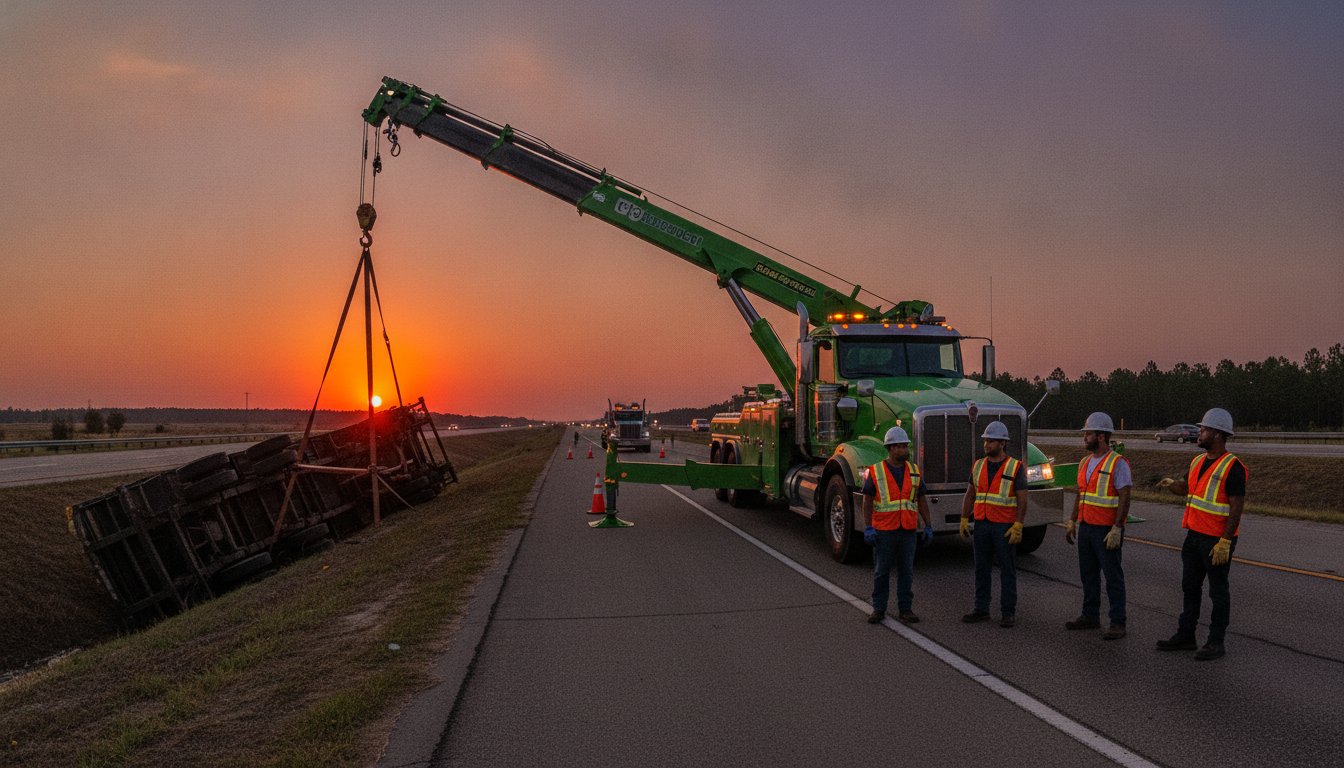
With over 12,000 semi-truck accidents occurring on Texas roads every year, the moment a rig leaves the pavement is the start of a high-stakes race against time. It’s a stressful experience that leaves drivers and fleet managers worried about more than just the initial crash. You’re likely concerned about the risk of secondary damage during the tow, the high costs of blocked highway lanes, and the safety of your cargo. We understand that in these critical moments, you need more than just a tow; you need a partner who brings calm competence to a chaotic scene.
This article outlines the vital safety protocols and specialized equipment requirements for professional truck recovery Texas operators use to keep scenes secure. You’ll gain a clear understanding of the industry standards that minimize downtime and protect your high-value assets. We’ll walk through five essential safety rules every driver should know, the functional differences between rotators and heavy-duty wreckers, and the specific steps required to upright a vehicle without compromising the load. By following these established procedures, you can ensure that a difficult situation is handled with the professionalism and integrity your business deserves.
Key Takeaways
- Understand the critical priority of establishing a safety perimeter and communicating cargo hazards to protect everyone at the scene.
- Discover how specialized equipment like heavy-duty rotators and airbag recovery systems prevent secondary damage to your rig and cargo.
- Learn why professional truck recovery Texas services focus on multi-point attachment to distribute stress safely during complex uprighting.
- Identify strategies for managing load shifts and transfers to minimize downtime and save high-value freight after an incident.
- Recognize how strategic location and family-owned values ensure a reliable, community-focused response for complex heavy recovery needs.
What Is Professional Truck Recovery in Texas?
Professional truck recovery Texas is a specialized field that goes beyond simply moving a disabled vehicle from one location to another. It involves the complex mechanical process of uprighting a rolled trailer, winching a rig out of a steep embankment, or extracting a vehicle from a non-drivable position. While standard towing handles mechanical breakdowns on the shoulder, recovery addresses incidents where the vehicle’s position itself is the primary obstacle. These high-stakes situations on our highways require technical expertise to protect the equipment, the driver, and the surrounding environment.
When a heavy-duty rig is incapacitated, the recovery team acts as a bridge between the accident and the return to service. This process is critical for infrastructure protection. A poorly managed recovery can lead to torn asphalt, destroyed guardrails, or compromised bridge supports. By using calculated lifting points and specialized machinery, professional teams ensure the job is done without adding to the state’s repair bill.
Recovery vs. Standard Towing
It’s helpful to view towing as the transport phase and recovery as the mechanical rescue that makes transport possible. Standard heavy-duty towing usually involves a truck that can still roll and is easily accessible. In contrast, recovery is necessary when a rig is involved in a rollover, a severe jackknife, or an off-road excursion into the soft Southeast Texas soil. A specialized recovery vehicle is often required to manage these immense loads without causing additional frame damage. Operators in our region undergo rigorous training to master these techniques, ensuring they can handle the weight of a fully loaded semi-truck with precision and care.
The Legal and Safety Framework in Texas
Scene management in the Lone Star State is a collaborative effort. The Texas Department of Public Safety (DPS) often oversees large-scale incidents to ensure traffic flow and public safety remain the top priority. Professional recovery teams must coordinate closely with local Dayton and Liberty County authorities to secure the area before work begins. This coordination is vital for adhering to the Texas “Move Over” laws, which mandate that drivers shift lanes or slow down when approaching emergency zones. Because of the extreme weights and physics involved, these operations require CDL-licensed recovery specialists who understand the unique handling characteristics of heavy-duty rigs. This professional oversight ensures that every step of the professional truck recovery Texas process meets strict state safety standards.
Specialized Recovery Equipment: Beyond the Standard Wrecker
Standard towing equipment often falls short when a rig is buried in the deep mud of a Southeast Texas ditch or overturned on a narrow shoulder. Successful professional truck recovery Texas operations rely on a suite of industrial-scale tools designed for precision rather than just raw pulling power. This arsenal includes heavy-duty winch services, which are essential for off-road extractions where the ground is too unstable for standard positioning. These winches utilize high-tensile wire rope to move massive weights slowly and safely. Adhering to standards for safe recovery operations ensures that every line and anchor point is inspected to prevent catastrophic failures during the pull.
The Power of the Rotator
The heavy-duty rotator is the “crane” of the towing world. A rotator is a specialized recovery vehicle with a rotating hydraulic boom. Unlike a standard wrecker that must be positioned directly in front of or behind a casualty, the rotator’s 360-degree rotation allows it to work from the side. This capability is vital on narrow Texas farm roads where there isn’t enough room to maneuver large equipment. These machines are built to handle the immense weight of a fully loaded 80,000-lb rig. By using outriggers for stability, a rotator can lift and pivot a trailer back onto the pavement with surgical accuracy.
Airbag Recovery for Cargo Protection
When a trailer is lying on its side, the biggest fear for any driver is the structural collapse of the trailer walls during the uprighting process. Airbag recovery systems solve this by using the physics of surface area. Instead of concentrated pressure from chains or straps, these heavy-duty bags are placed under the trailer and inflated. This distributes pressure across a large section of the trailer skin, preventing the “crushing” effect often seen with traditional methods. It’s the preferred choice for temperature-sensitive freight or high-value loads that can’t withstand jarring movements. JTT Towing provides specialized airbag recovery for Dayton clients who need to protect their cargo at all costs.
Before any movement begins, operators use load shift equipment to stabilize shifting cargo within the trailer. This might include hydraulic jacks, timber cribbing, or specialized straps to ensure the weight doesn’t move during the lift. Stabilizing the load is just as important as the lift itself, as it prevents secondary damage to the vehicle’s frame. Professional recovery teams prioritize these technical steps to ensure the rig remains intact throughout the process.
Overcoming the Fear of Secondary Damage During Recovery
The sight of a heavy wrecker arriving at an accident scene often triggers a specific anxiety for drivers and fleet owners. You might wonder if the process of uprighting your rig will cause more damage than the initial incident. This fear is valid. A botched recovery can turn a repairable tractor into a total loss by twisting the frame or crushing the trailer walls. Reliable professional truck recovery Texas operators prioritize the preservation of your equipment through calculated physics and careful planning.
Professional teams often spend at least 20 minutes conducting a thorough initial assessment before a single winch line is tightened. They calculate the center of gravity and identify the most stable angles for the pull. This planning phase is not a delay; it is an essential engineering step. By using multi-point attachment strategies, operators distribute the immense stress of the lift across several reinforced areas of the chassis rather than pulling from a single hook. This method prevents frame bowing and protects the suspension components from unnecessary strain.
If the trailer’s structural integrity is compromised, the safest path forward involves moving the cargo before the vehicle is moved. Attempting to upright a trailer with a shifted or heavy load can lead to a catastrophic “side-wall blow-out.” To prevent this, specialized teams, such as those at JTT Towing and Storage, offer load shift and transfer services to relocate the freight to a secondary trailer. This extra step ensures that both the high-value cargo and the original trailer remain intact throughout the recovery process.
The Science of Rigging
Rigging is a technical discipline that requires identifying specific structural “hard points” on a tractor-trailer. Specialists focus on axles, heavy-duty suspension brackets, and reinforced frame rails to secure their lines. They are trained to avoid “shock loading,” which occurs when a winch line is jerked suddenly. Instead, a methodical and steady pull is used to maintain constant tension. This controlled approach minimizes the risk of metal fatigue and ensures that the rig moves exactly as intended.
Site Clearing and Environmental Safety
Once the vehicle is upright and secure, the recovery team’s duty extends to the surrounding environment. Texas highways must be cleared of all debris, glass, and automotive fluids to prevent secondary accidents for other motorists. Professional crews are equipped to manage diesel or oil spills, protecting the local Southeast Texas soil from contamination. Providing a “clean scene” guarantee means the roadside in Dayton or Liberty County is left in a safe, stable condition. This comprehensive care reflects a commitment to both the client’s assets and the safety of the community.
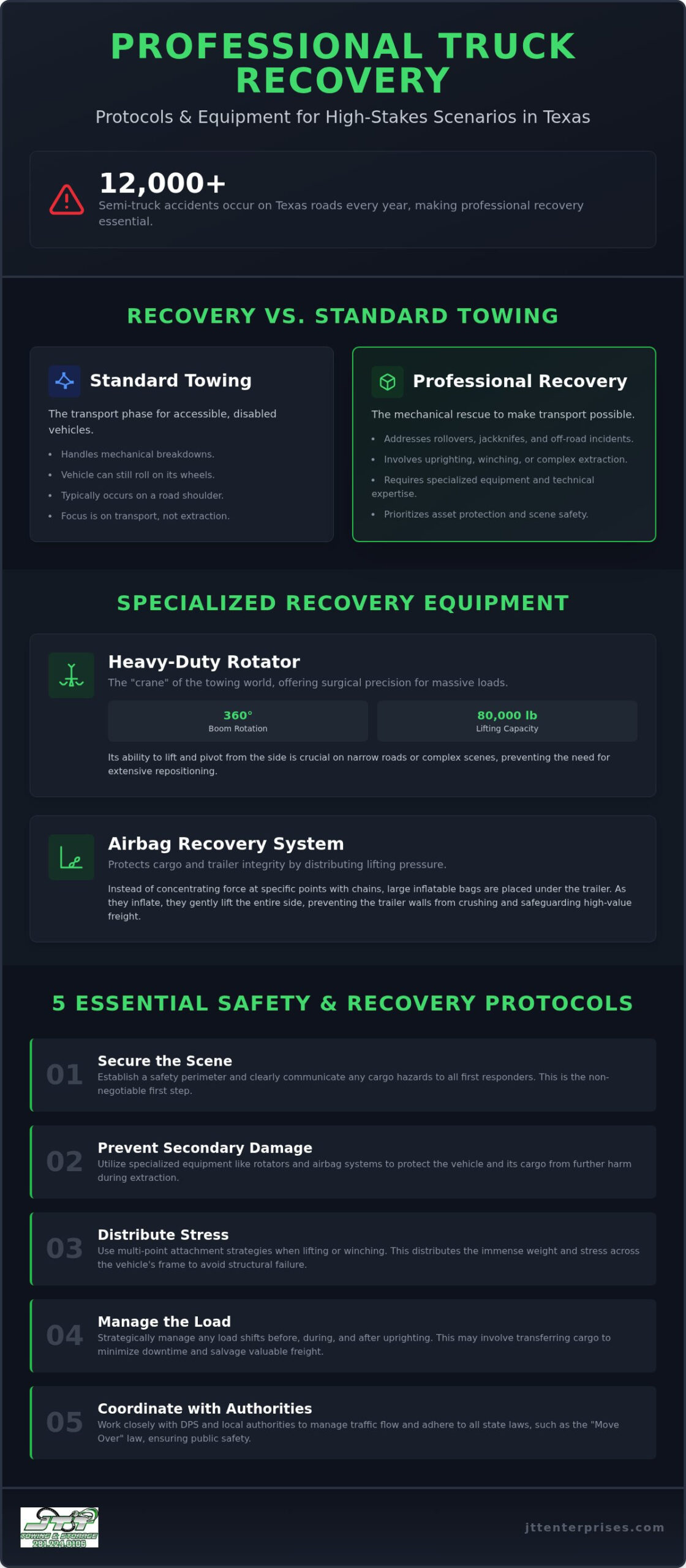
The 5 Essential Safety Rules for a Professional Recovery Operation
While specialized equipment does the heavy lifting, the safety of the scene depends heavily on the actions of the driver before and during the process. A professional truck recovery Texas operation is a coordinated effort where every person on-site has a specific role to play. Following these five essential rules ensures that the recovery proceeds smoothly without further injury or incident. It’s about protecting the people first, then the equipment.
Rule 1 & 2: Preparation and Communication
The moments immediately following an accident are often the most dangerous. On high-speed corridors like Hwy 90, traffic remains a constant threat to anyone standing on the shoulder. Your first priority is to establish a clear safety perimeter. A safety perimeter is defined as the minimum 50-foot radius required around a recovery operation to protect personnel from moving traffic and equipment failure. You should use cones, triangles, or flares to alert oncoming drivers and create a buffer zone for the incoming recovery team.
Clear communication is the second pillar of a safe scene. The recovery operator needs specific technical details to choose the right equipment and rigging. This information is the foundation of a safe professional truck recovery Texas mission. Be prepared to provide the following details to the dispatcher or lead operator:
- The total estimated weight of the tractor and trailer.
- The specific type of cargo and whether it has shifted or is hazardous.
- The integrity of the fuel tanks and the presence of any visible leaks.
- The terrain conditions, such as steep embankments or soft mud.
Rule 3, 4 & 5: Execution and Documentation
Once the recovery team arrives, you must yield control of the scene to the recovery specialist. They act as the pilot of the operation, managing the physics of the lift. Professional teams often utilize a “spotter” who monitors the rigging and traffic while the operator focuses on the controls. This second set of eyes is vital for catching small shifts in the load before they become major problems.
During the actual pull, all personnel must remain in a designated safe zone. If you’re instructed to stay in the cab, do so. If you’re outside, move behind a permanent barrier or well outside the 50-foot perimeter. Cables under tension store immense energy. If a line snaps, the “snap-back” zone can be lethal. You should never stand in a direct line with a winch cable or chain.
Finally, documentation is your best tool for insurance and liability protection. Take clear photos of the scene from multiple angles before the recovery begins. Document the position of the rig, the state of the cargo, and any existing damage. Once the vehicle is upright, take a second set of photos to verify the success of the operation. For reliable assistance from a team that prioritizes these strict safety protocols, contact JTT Towing for your heavy-duty recovery needs.
Why JTT Towing is Dayton’s Trusted Partner for Heavy Recovery
JTT Towing and Storage is more than just a service provider; we are a family-owned operation with over 10 years of experience serving the Southeast Texas community. We understand that behind every rig is a driver’s livelihood and a fleet’s reputation. This perspective drives our team to treat every vehicle with the same care we would give our own. Our strategic location in Dayton, TX, positions us as a central hub for professional truck recovery Texas operations, allowing us to respond quickly to incidents across Liberty County and major transit routes like Hwy 90.
Our team provides a full spectrum of commercial support. Whether you need a simple jumpstart or a complex 100-ton recovery involving a heavy-duty rotator, we have the industrial-scale equipment to handle the task. We offer heavy-duty towing, off-road recovery, and equipment hauling to ensure your fleet stays moving. Because accidents don’t follow a 9-to-5 schedule, we maintain constant readiness. You can count on us to be there when the situation is most urgent, providing the stability and calm competence required for high-stakes scenes.
The JTT Difference: Professional Assurance
Our commitment to excellence starts with ongoing training and a focus on certified recovery operations. We don’t just clear the road. We provide a comprehensive solution that protects your bottom line. This includes secure vehicle storage to protect your assets after the recovery is complete. Additionally, our unique synergy with our professional truck repair shop means we can often streamline the transition from the accident scene to the repair bay. By combining neighborly reliability with industrial capability, we bridge the gap between small-town service and large-scale recovery expertise.
Contact JTT for Emergency Support
When you face an incident in Dayton (77535), Huffman (77336), or the surrounding areas, getting the right help quickly is vital. Our dispatchers are trained to gather critical information immediately to ensure the right equipment arrives at your location. To dispatch our team, provide your exact location, the nature of the casualty, and any specific cargo details. We’re prepared to handle load shifts and transfers on-site to save your freight and minimize cargo loss. Trust JTT Towing and Storage for professional truck recovery in Texas.
Securing Your Fleet’s Success on Texas Highways
Successful recovery operations depend on more than just heavy machinery. It’s a precise coordination of technical skill, specialized equipment like rotators and airbags, and strict adherence to safety perimeters. By understanding these protocols, you can minimize the risk of secondary damage and ensure that your high-value cargo remains protected during the most stressful moments on the road. When you prioritize these standards, you aren’t just clearing a scene; you’re protecting your business’s bottom line and the safety of everyone involved.
JTT Towing and Storage has provided over 10 years of family-owned service in Dayton, TX. We combine industrial-scale capability with the personal accountability of a neighbor. Our team is ready to assist with everything from specialized airbag recovery to comprehensive truck repair and secure vehicle storage. If you find yourself in an urgent situation, don’t face it alone. Contact JTT Towing and Storage for 24/7 Emergency Recovery and get the professional truck recovery Texas fleets trust to get the job done right. We’re here to be the reliable partner you need to move forward safely.
Frequently Asked Questions
What is the difference between heavy-duty towing and truck recovery?
Heavy-duty towing is the transport of a vehicle that is already in a position to be moved, usually following a mechanical breakdown. In contrast, recovery is the technical process of rescue. It involves uprighting an overturned rig, winching a vehicle from a ditch, or extracting it from an embankment. Professional truck recovery Texas specialists use specialized rigging and rotators to return the vehicle to a drivable or towable state.
Does professional recovery always cause damage to the trailer?
Professional recovery is specifically designed to minimize or prevent secondary damage. Experienced teams conduct a thorough assessment to identify structural hard points and use multi-point attachment strategies to distribute stress. While the initial accident causes the primary damage, a methodical recovery process using the right equipment protects the frame and suspension. The goal is always to preserve the vehicle’s integrity so it can be repaired and returned to service. For owners who want to further protect their vehicle’s finish and long-term value, check out J9’s Luxury Auto Detailing.
Airbag recovery uses high-pressure pneumatic cushions to lift or upright overturned trailers without the need for traditional chains. It’s the preferred method when a trailer’s side walls are fragile or when the cargo is high-value and sensitive to jarring movements. By spreading the lifting force over a large surface area, this technique prevents the trailer from crushing. It’s a vital tool in professional truck recovery Texas operations for protecting freight.
How long does a typical professional truck recovery take in Texas?
The timeline for a recovery depends on the complexity of the scene, but a standard uprighting often takes between two and four hours once the team arrives. Factors such as cargo weight, environmental conditions, and traffic management on busy corridors can influence the duration. A complex off-road winching operation or a scene involving hazardous materials may take significantly longer. Our teams prioritize a steady, safe pace to ensure the scene remains secure.
Will my insurance cover the cost of professional truck recovery?
Most commercial insurance policies cover recovery costs under wrecking, removal, or cargo protection clauses. You should verify the specific details of your coverage with your provider. To assist with your claim, professional teams provide detailed documentation, including itemized invoices and scene photos. While every policy is unique, these services are generally recognized as necessary steps to mitigate further loss, protect the environment, and clear public infrastructure after a major incident.
What should I tell the dispatcher when calling for a heavy recovery?
You should provide your exact location, the vehicle’s current position, and a detailed description of the cargo. Mention if the rig is overturned, in a ditch, or if there are fluid leaks. Accurate weight estimates are critical because they help the dispatcher send the correct equipment, such as a heavy-duty rotator or an airbag system. Describing the terrain, such as soft mud or steep slopes, ensures the team arrives fully prepared for the challenge.
Can JTT Towing handle off-road recovery for construction equipment?
Yes, our team is fully equipped to handle off-road recovery for various types of heavy machinery and construction equipment. We use high-capacity winches and specialized rigging to extract equipment from challenging terrain like mud, sand, or steep embankments. Whether you have a bulldozer, excavator, or paver, we apply the same technical precision used in semi-truck recovery. We focus on moving your valuable equipment safely without causing additional mechanical strain or frame damage.
Does JTT Towing provide load shift and transfer services in Dayton?
Yes, our team is fully equipped to handle off-road recovery for various types of heavy machinery and construction equipment. We use high-capacity winches and specialized rigging to extract equipment from challenging terrain like mud, sand, or steep embankments. Whether you have a bulldozer, excavator, or paver, we apply the same technical precision used in semi-truck recovery. Companies like Allout Towing demonstrate how these specialized recovery principles are applied globally to protect high-value assets. We focus on moving your valuable equipment safely without causing additional mechanical strain or frame damage.