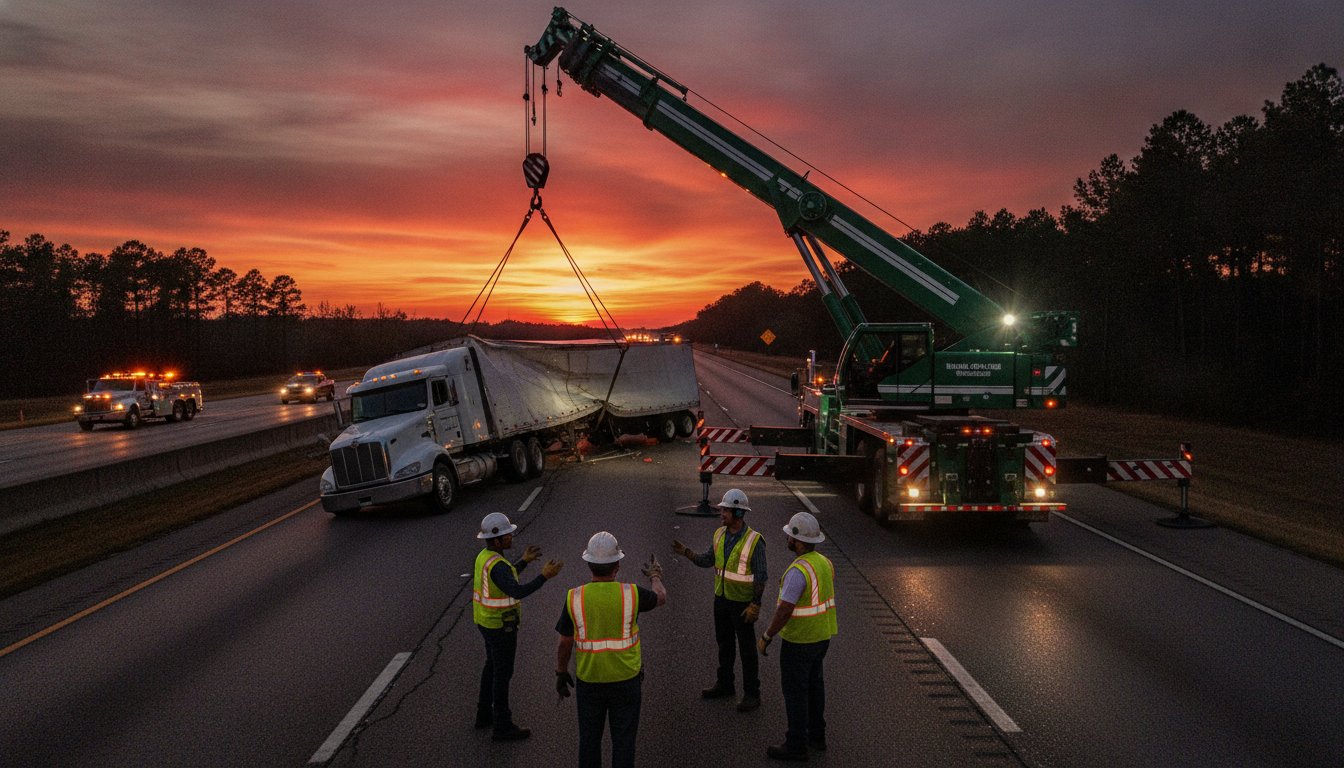
A single miscalculated pull on a jackknifed trailer can turn a recoverable incident into a total loss in seconds. When your rig is folded across a Liberty County highway, the pressure to clear the road often leads to rushed decisions and costly secondary damage. Professional jackknife truck recovery is not about brute force; it’s a precision engineering task that requires specialized knowledge of weight distribution and mechanical limits. You need a partner who understands that your equipment and your cargo represent your livelihood.
We recognize the gut-wrenching stress of watching a heavy-duty wrecker hook up to your truck. You’re likely worried about the integrity of your fifth wheel, the risk of a load shift, or the mounting costs of extended downtime on Texas corridors. This guide will teach you the specialized techniques, equipment, and safety protocols professionals use to save your rig without causing further harm. We’ll examine the role of rotator cranes in modern recovery, explain how to protect your trailer’s frame, and help you identify a reliable recovery partner in the Dayton area who treats your fleet like their own.
Key Takeaways
- Professional jackknife truck recovery requires precise calculations to protect the fifth wheel and prevent snapping the kingpin during the realignment process.
- Specialized tools like heavy-duty rotators and airbag recovery systems allow teams to lift your trailer safely rather than dragging it across the pavement.
- Securing the scene with flares and triangles is the first critical step in protecting your rig and other drivers on high-speed Texas highways.
- Multi-point winching provides the steady control necessary to undo a fold without risking secondary damage to the tractor or cargo.
- Working with a local partner who has over 10 years of experience in Liberty County provides the peace of mind that your equipment is in capable hands.
What is Jackknife Recovery? Understanding the High-Stakes Scenario
Professional jackknife truck recovery is the technical process of realigning a semi-tractor and trailer after they’ve folded into an acute V-shape. This position is one of the most precarious situations a driver or fleet manager can encounter on the road. To grasp the complexity of the task, it helps to understand the physics involved. What is jackknifing? Essentially, it’s a mechanical failure of momentum where the trailer tries to overtake the tractor. This usually results in the rig blocking multiple lanes, creating a massive safety risk for everyone on the highway.
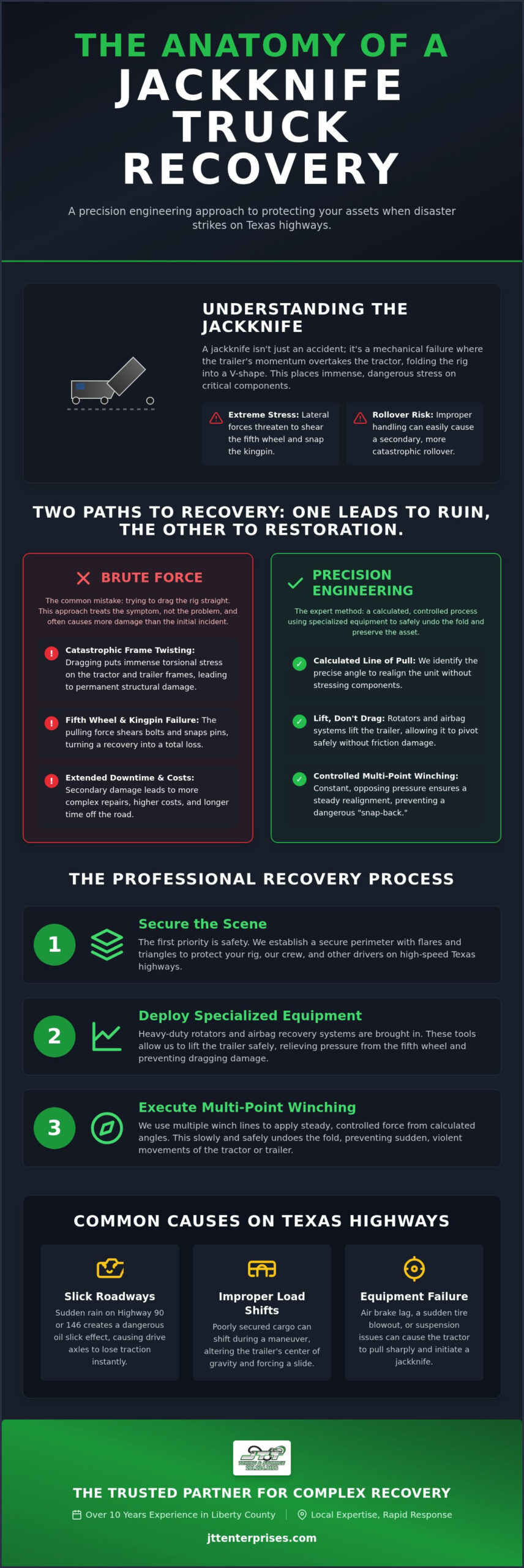
The situation is critical because a folded rig places extreme lateral stress on the fifth wheel and the kingpin. These components are designed for pulling, not for resisting the sideways force of a 40,000-pound trailer. When the angle becomes too severe, the rig reaches what recovery experts call the “point of no return.” This is the instant the trailer’s side wall or nose makes physical contact with the tractor’s cab. Once this happens, structural damage is almost guaranteed. Our primary goal during any recovery is to stabilize the entire unit. We focus on preventing a secondary rollover, which is a common risk when an untrained operator attempts to pull a rig straight without managing the load’s center of gravity.
The Mechanics of a Jackknife Accident
A jackknife typically begins when the drive axles lose traction. When these wheels can’t grip the pavement, they lose their ability to lead the trailer. Instead, the trailer’s momentum pushes against the tractor’s rear. The fifth wheel pin serves as the pivot point for this mechanical disaster. As the trailer swings out, it creates a whip-like effect. Many drivers instinctively hit the brakes hard to stop the slide. Unfortunately, this often locks the wheels and removes any remaining steering control, which only tightens the fold and increases the severity of the accident.
Common Causes on Texas Highways
Operating a heavy rig in Liberty County presents unique challenges that can lead to these incidents. Understanding the causes helps in preparing for the recovery effort:
- Slick Roadways: Sudden rain on Highway 90 or Highway 146 creates a dangerous “oil slick” effect on the asphalt.
- Load Shifts: Improperly secured materials can shift during a sudden maneuver, instantly changing the trailer’s center of gravity and forcing a slide.
- Equipment Issues: Air brake lag or a sudden tire blowout on a steering axle can cause the tractor to pull sharply, initiating a jackknife.
Executing a safe jackknife truck recovery requires a deep understanding of these mechanical failures. We don’t just see a stuck truck; we see a complex puzzle of force and friction that needs to be solved with care and precision; a standard of professional excellence you can also find when you discover Tortuga Pools for expert swimming pool cleaning and maintenance.
The Physics of Recovery: How Professionals Undo the Fold
Undoing a jackknife is a delicate balance of tension and friction. Rushed or inexperienced operators often try to drag the rig straight, but this brute-force approach leads to catastrophic frame twisting and suspension failure. According to official government statistics, these incidents are a frequent challenge in the heavy trucking industry, and the recovery phase is often where the most expensive secondary damage occurs. A successful jackknife truck recovery depends on calculating the precise “Line of Pull.” We identify the exact angle needed to realign the unit without putting undue lateral stress on the kingpin. If the pull vector is off by even a few degrees, the pressure can shear the fifth wheel bolts or permanently warp the trailer’s nose.
Managing kinetic energy is the most dangerous part of the professional recovery process. When a folded rig is under thousands of pounds of winching tension, it naturally wants to snap back into a straight line with explosive force. If this isn’t carefully controlled, the sudden momentum can cause a loaded trailer to tip over or the cab to lurch violently into the recovery zone. We use multi-point winching systems to maintain constant, opposing pressure on both the tractor and the trailer. This methodical approach ensures the rig realigns with a steady, predictable motion rather than a dangerous snap. Understanding the essential safety rules for professional truck recovery in Texas can help drivers and fleet managers recognize why these controlled techniques are so critical to protecting equipment and personnel.
Stabilizing the Tractor
Before the first winch line is even tightened, we must turn the recovery vehicle and the disabled tractor into a fixed, immovable system. We use heavy-duty wheel chocks and wide-stance hydraulic outriggers to prevent the wrecker from shifting under the immense weight of the load. An anchor point is a fixed position used to redirect winching force. By securing the tractor’s frame directly to these points, we ensure it remains a stable platform throughout the procedure. This stability prevents the tractor from sliding toward the trailer, a common mistake that only tightens the jackknife angle and complicates the job.
Controlling the Trailer Swing
The trailer is the most unpredictable element in a recovery, especially when it’s fully loaded or carrying a liquid cargo that can slosh. We utilize secondary winch lines and snatch blocks to multiply our pulling power and create the necessary mechanical advantage for a precise side-pull. This setup allows us to guide the trailer back into its lane with literal inches of precision. During the move, we carefully manage the trailer’s air brakes. We release them only when the tension is perfectly balanced to avoid flat-spotting the tires or damaging the brake drums. If you’re facing a complex situation on a Liberty County highway, our team provides expert accident recovery that prioritizes the long-term integrity of your equipment.
Specialized Equipment Used in Complex Heavy Recovery
Success in jackknife truck recovery depends as much on the hardware as it does on the operator’s skill. Standard wreckers are often limited to straight-line pulls. These aren’t enough when a rig is wedged against a concrete barrier or folded into a tight V-shape. We utilize a suite of heavy-duty tools designed to manipulate 80,000-pound combinations with surgical precision. This includes high-capacity winches with 50,000-pound lines that provide the steady, controlled movement required to realign a tractor without snapping cables or damaging the frame.
The Advantage of the Rotator
The heavy-duty rotator is the most versatile tool in our fleet. Unlike traditional wreckers, a rotator features a boom that rotates 360 degrees. This allows us to lift a trailer vertically rather than dragging it across the asphalt. In tight spots on Highway 90 or Highway 146, we can often complete a recovery while staying within a single lane. Rotators are the gold standard for jackknife truck recovery in tight spaces because they offer vertical clearance that a standard wrecker lacks. Hydraulic lifting is significantly more precise than cable winching alone, allowing us to pivot a trailer back into alignment without putting stress on the suspension.
Airbag Recovery for Sensitive Loads
When a trailer is overturned or leaning at a dangerous angle, standard chains can crush the thin aluminum side walls. We use specialized airbag recovery systems to solve this problem. These low-pressure bags are placed strategically under the trailer and inflated slowly to distribute lifting force across a wide surface area. This method is essential for protecting perishable or fragile cargo. It’s often the only viable option for uprighting a trailer without compromising the structural integrity of the box or the value of the load inside.
Load Shifts and Transfers
Many jackknife incidents are caused by imbalanced cargo that shifted during transit. Even after the truck is straight, it may be unsafe to drive until the weight is redistributed. We bring pallet jacks and forklifts directly to the scene to correct these imbalances. If the trailer is too damaged to continue, we facilitate on-site transfers to a secondary trailer to keep your delivery on schedule. You can Learn more about our load shift services to see how we handle these high-stakes cargo situations and prevent secondary accidents.
Step-by-Step: What to Do After a Jackknife in Dayton, TX
The seconds following a jackknife accident are often a blur of adrenaline and stress. Your priority must immediately shift from driving to scene management to protect yourself and the public. On high-speed corridors like Highway 90 or Highway 146, a disabled rig is a major hazard that requires instant visibility. You should deploy your reflective triangles and flares immediately, placing them at intervals that give oncoming traffic plenty of time to react to the obstruction. Once the perimeter is set, perform a quick walk-around to check for fuel leaks or hazardous material spills. Reporting these details early helps the response team bring the correct containment equipment.
Clear communication with your dispatcher and the recovery team is the next vital step. When you call for a jackknife truck recovery, don’t just say you’re “near Dayton.” Provide a specific mile marker or a nearby landmark like the Trinity River bridge. This precision allows the heavy-duty operator to plan their approach route, ensuring they don’t get caught in the same traffic backup your rig is causing. If you’re currently in an emergency situation, our team is ready to provide immediate heavy-duty towing and recovery services throughout Liberty County.
Securing the Scene in Liberty County
Traffic in our region moves fast, and managing the flow around a folded trailer is dangerous work. We often coordinate with local law enforcement to establish a safe “work zone” for the recovery. While waiting for help to arrive, stay clear of the “danger zone.” This is the area inside the “V” formed by the cab and trailer. If the rig shifts or a component fails, this area becomes a crush point. Stay on the shoulder or behind a guardrail, keeping a sharp eye on traffic until the recovery specialists arrive to take over the scene.
Providing the Right Data to Your Recovery Specialist
A recovery specialist needs more than just a location to execute a safe jackknife truck recovery. Before they arrive, try to gather the following technical details to speed up the process:
- Total Weight and Cargo: Is the trailer empty, or are you hauling a full 80,000-pound load of heavy machinery?
- Angle and Position: Is the trailer still on the pavement, or have the rear tandems slid into a ditch?
- Mechanical Status: Can the wheels still roll, or did the impact lock the air brakes or snap an axle?
Providing this data upfront ensures the operator arrives with the right combination of rotators, snatch blocks, and winch capacity to get you moving again without delay. Familiarizing yourself with the safety protocols that professional truck recovery Texas operators follow can also help you communicate more effectively with the response team and understand what to expect during the process. This focus on equipment readiness is essential for any large vehicle operation, including recreational travel services like troyersrvrental.com that prioritize fleet safety.
Why JTT Towing is the Trusted Partner for Complex Recovery
JTT Towing and Storage has served the Dayton and Liberty County community since 2012. As a family-owned operation with over 10 years of established service, we understand that a highway incident is more than just a mechanical failure. It’s a disruption to your business, your schedule, and your peace of mind. Our team approaches every jackknife truck recovery with a blend of professional assurance and neighborly reliability. We don’t just see a rig; we see a partner who needs a steady hand during a high-stakes situation. Our deep roots in the region mean we treat every recovery with the integrity and care your fleet deserves.
Our commitment to excellence is backed by a specialized fleet that most smaller operators simply cannot match. We’ve invested in heavy-duty rotators and airbag recovery systems to ensure we can handle the most complex scenarios without causing secondary damage. This technical proficiency allows us to act as a dependable anchor for drivers and fleet managers alike. Whether you’re dealing with a simple slide-off or a catastrophic fold, we have the specialized equipment and the seasoned expertise to preserve your assets and clear the road efficiently.
24/7 Readiness for Commercial Fleets
Accidents don’t follow a schedule, and neither do we. We provide 24/7 emergency response for commercial fleets, ensuring that help is always available when a crisis occurs on Highway 90, Highway 146, or other major Texas corridors. Our “Reliable Guardian” approach means we arrive ready to take charge of the scene, allowing you to focus on your drivers and your cargo. Beyond the immediate jackknife truck recovery, we offer secure vehicle storage for recovered assets. This provides a protected location for your equipment while insurance adjustments or long-term repair plans are finalized.
Expertise Beyond the Tow
A successful recovery is often only the first step in getting your business back on track. Because we offer comprehensive truck repair and load shifts and transfers, we can address the logistical challenges that follow a collision. If your cargo shifted during the incident, we manage the transfer to a secondary trailer to protect your delivery deadlines. Our on-site repair capabilities mean that minor mechanical issues don’t have to result in weeks of downtime. We combine the power of a large-scale operation with the personal accountability of a local business to get your wheels turning again. Contact JTT Towing and Storage for 24/7 Heavy Recovery to experience the difference that professional expertise and community focus can make for your fleet.
Protecting Your Fleet and Your Future
A jackknife incident is a defining moment for any trucking operation. It tests the limits of your equipment and the reliability of your recovery partner. As we’ve explored, successful jackknife truck recovery relies on a deep understanding of physics and the use of specialized tools like rotators and airbag systems. Choosing precision over brute force ensures that your trailer frame and fifth wheel remain intact, allowing you to return to the road with minimal long-term damage.
When the pressure is high on a Liberty County highway, you don’t have to face the crisis alone. JTT Towing and Storage provides the technical expertise and neighborly care required to handle these complex situations. With our 24/7 Emergency Response and Certified Rotator Operators, we act as a reliable guardian for your rig and cargo. We also offer a Secure Storage Facility in Dayton to protect your assets while you plan your next move. Get Professional Heavy-Duty Recovery Support Now and let our team restore your peace of mind. Your rig is an investment; we’re here to help you protect it.
Frequently Asked Questions
How long does a jackknife recovery typically take?
A professional recovery can take anywhere from one to four hours depending on the complexity of the fold and the cargo weight. If the rig is blocking a major highway like Highway 90, our team prioritizes rapid stabilization to clear the road. Factors such as weather conditions and off-road positioning also influence the duration. We focus on a methodical approach to ensure no secondary damage occurs during the process.
Will my insurance cover the cost of a rotator for recovery?
Most commercial auto insurance policies cover the use of specialized equipment like rotators when it is required for a safe recovery. Since a rotator prevents additional damage to the cab and trailer, insurance adjusters often prefer its use over traditional dragging methods. You should review your specific policy limits, as many carriers have established caps for towing and recovery services based on the incident’s severity.
Can a jackknifed truck be driven after it is straightened?
A truck shouldn’t be driven immediately after a jackknife without a thorough mechanical inspection. The extreme lateral forces involved in the accident often damage the fifth wheel, snap air lines, or warp the tractor frame. Even if the rig looks straight, hidden structural issues or brake system failures could lead to another accident. Safety dictates that a qualified technician clears the vehicle for service before it returns to the highway.
What is the difference between a standard tow and a heavy recovery?
Standard towing involves a straightforward hookup and transport of a vehicle that is already on its wheels and rolling. In contrast, jackknife truck recovery is a heavy recovery operation that requires winching, lifting, and complex rigging. This process is necessary when a vehicle is overturned, stuck, or structurally compromised. Heavy recovery utilizes advanced machinery like rotators to manipulate the rig’s position with high precision and steady control.
How do you prevent a trailer from flipping during recovery?
We prevent trailers from flipping by using multi-point winching and maintaining constant tension on the high side of the load. By calculating the center of gravity and using a rotator’s vertical lift, we can guide the trailer back into alignment without allowing it to tip. This controlled movement is essential when dealing with top-heavy loads or liquid cargo that might shift and create unpredictable momentum during the recovery move.
Do you provide load transfer services if my trailer is damaged?
We provide comprehensive load shifts and transfers if your trailer is too damaged to safely continue its journey. Our team brings the necessary equipment, such as pallet jacks and secondary trailers, directly to the scene in Liberty County. This service ensures your cargo reaches its destination on time even if the original rig requires extensive repairs. We handle everything from palletized freight to heavy materials with professional care and efficiency.
What areas around Dayton, TX do you serve for heavy recovery?
Based in Dayton, we serve all major corridors throughout Liberty County and the surrounding regions. Our response teams frequently handle recoveries on Highway 90, Highway 146, and FM 1960. We are positioned to reach commercial fleets quickly, providing a dependable anchor for drivers stranded in rural areas or on high-traffic highways. Our local knowledge allows us to navigate to your exact location without unnecessary delays during an emergency.
Is airbag recovery safer for the cargo than traditional winching?
Airbag recovery is significantly safer for cargo than traditional winching because it distributes lifting force over a much larger surface area. Traditional chains or cables can concentrate pressure on a single point, often crushing the thin aluminum walls of a trailer. Low-pressure airbags gently upright the trailer, which is especially critical for perishable goods or fragile freight. This specialized jackknife truck recovery method preserves the value of your load and equipment.